
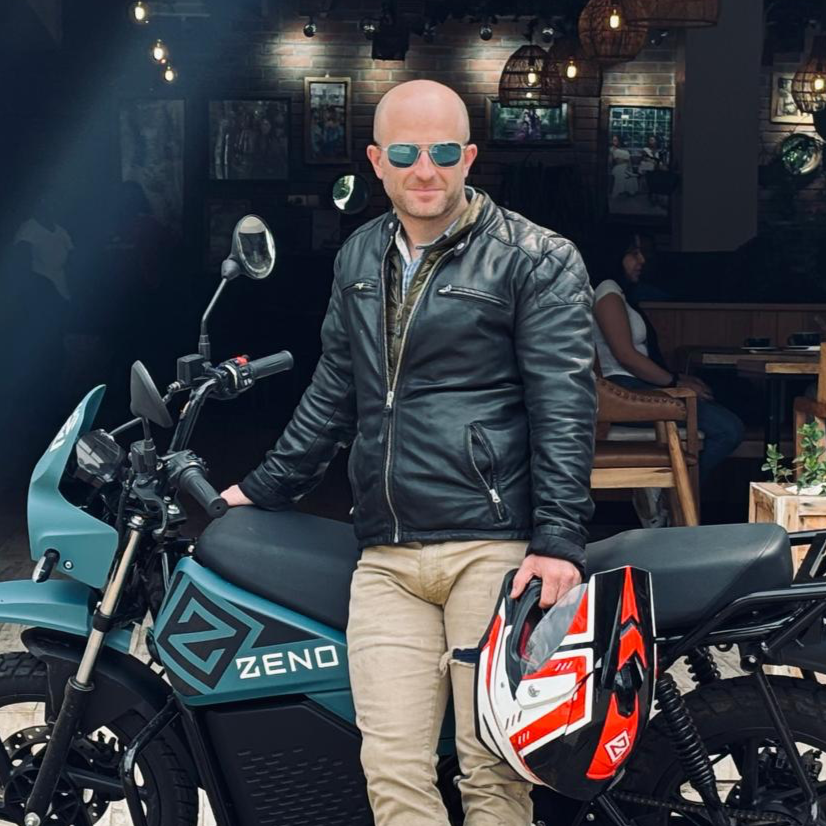
Michael Spencer is the Founder and CEO of Zeno, an electric mobility company building electric motorcycles, battery-swapping infrastructure, and distributed energy systems across East Africa. Drawing on experience from nearly a decade building businesses in East Africa and four years at Tesla during its hypergrowth era, Spencer is applying lessons from EV charging infrastructure to one of the world's largest transportation markets: two- and three-wheel vehicles.
In this episode of Inevitable, Spencer explains why electrifying motorcycles in emerging markets may be one of the most efficient ways to reduce transportation costs and emissions. He discusses how Zeno combines hardware, software, and energy infrastructure to create a business that looks like an electric vehicle company on the surface but increasingly operates like a distributed utility.
The conversation explores lessons from Tesla’s Supercharger network, why Kenya became Zeno’s launch market, how battery swapping and AI-powered infrastructure management drive capital efficiency, and why building hard-tech businesses may become even more valuable in an AI-driven world. Spencer also shares his vision for turning Zeno’s charging network into a distributed renewable energy platform capable of serving both mobility and grid customers.
Note: Zeno is an MCJ portfolio company
Episode recorded on June 8, 2026 (Published on June 23, 2026)
In this episode, we cover:
[03:00] From East Africa to Tesla: Michael's path
[04:36] Inside the supercharger rollout — and what it really taught him
[08:02] Why two-wheelers are paradoxically easier to electrify
[10:17] The Kenya opportunity: spending half your income on fuel
[16:19] 200 charge points, $8M spent — how they did it
[20:27] The AI matching algorithm behind 75% network utilization
[23:20] Building a world-class team across four continents
[28:17] Supply chain, oil prices, and the double-edged sword
[32:03] Why hardware can't be vibe-coded
[36:41] The five-year vision: from motorcycle company to distributed utility
-
Yin Lu (00:00):
Today on Inevitable, our guest is Michael Spencer, CEO of Zeno. Recently at San Francisco Climate Week, we overheard two people at a cocktail hour debating Zeno, which is an MCJ portfolio company. One said, Zeno, I think they're just another electric motorcycle company. The other replied, "Nope, they're a distributed renewable energy utility hiding in the Trojan horse of an electric motorcycle company." That conversation is exactly why I wanted to do this episode. We spent a lot of time on the show talking about companies in the US building solutions to keep our infrastructure, namely the grid, running under stress as power demand keeps rising. Zeno is doing something in that same spirit but in a very different part of the world. I'm Yin Lu, partner at MCJ, taking over the mic, and today I'm joined by Michael. Before Zeno, Michael spent nearly a decade building businesses in East Africa and four years inside Tesla working on model three and Model Y production, rooftop solar, and the early supercharger rollout.
(00:58):
In this conversation, he makes the case that two-wheelers and emerging markets are paradoxically far easier to electrify and roll out than premium sedans and that Kenya offers the single greatest opportunity for consumer value creation he's found anywhere in the world. He breaks down how Zeno got to roughly 200 charge points and are now making 500 deliveries a month on a fraction of the cost of their competitors and how their AI managed battery swapping network hits utilization rates five to 20 times those of US fast chargers and why he believes AI-powered physical infrastructure, not software, is where the durable moat sits. The Zeno team is running full speed ahead to achieve its five-year plan to build the most ambitious, distributed, renewable energy utility in the global south with mobility as the beachhead.
Cody Simms (01:49):
From MCJ, I'm Cody Simms and this is Inevitable. Climate change is inevitable. It's already here, but so are the solutions shaping our future. Join us every week to learn from experts and entrepreneurs about the transition of energy and industry.
Yin Lu (02:16):
Well, Michael, welcome to the MCJ Inevitable Podcast. It's so nice to have you here.
Michael Spencer (02:20):
Thanks very much for having me. Excited to have the conversation.
Yin Lu (02:23):
Before we get into your story, give me the 30-second version of what Zeno is, just so everyone is in the same place before we jump into the details.
Michael Spencer (02:31):
At first glance, we're an electric mobility company. We make and sell electric motorcycles in the parts of the world where those are their primary means of transportation for the vast majority of the population. But when you peel the first layer of what we do back, we are in a lot of ways a distributed utility company. So we sell electric vehicles, but we also then sell the energy that power them. And so when you look at our business today, we look like one-part automotive company, one-part motorcycle company, and one-part utility.
Yin Lu (03:00):
Before Zeno, you spent a bunch of years building in East Africa and then you went deep into Tesla, you were on model three and model Y production. You were one of the people that saw the early supercharger deployment across the US and Europe. That's a pretty specific combination. I think that's what drew MCJ to you when we invested, but how did your path lead you here?
Michael Spencer (03:22):
I read a book called Cradle to Cradle as I was finishing architecture school in 2010. And it was one of the kind of early Jan books on how to think about a different way of living in human existence. And that really shaped a lot of my thinking around architecture and what I wanted to do with my life. And so I ended up in East Africa, first working on a sustainable, affordable housing company out of an architecture thesis project, how to house people more affordably and more sustainably and got what I thought was going to be a several month long project turned into close to a decade in the East African region where I fell in love with building impactful foundational kind of businesses, helping people live healthier lives, more sustainable lives and built a lot of experience doing that and then had a unexpected detour in life where I was recruited to join Tesla and spent four years there and arguably the most transformative part of the company's growth period.
(04:17):
And as I was finishing third year at Tesla, was starting to think about what I was going to go and work on next that was most important for humanity, but also would leverage the experiences and the skills that I had acquired to date at that point. And that's what brought me to building what we were building as Zeno.
Yin Lu (04:36):
Having spent time on the inside of Supercharger rollout, which I think is arguably one of the most successful EV infrastructure deployments in history, what's the global insight that you took away?
Michael Spencer (04:47):
One part is just one of the things that we did really well at Tesla that I don't think is still fully appreciated by a lot of people. This whole space is a very big swing space. It is a high stakes poker game where you have to show up with a lot of money, but when you can show up with a lot of money, there's a lot of money to be made. Tesla did an excellent job of simultaneously solving for excellent product and excellent service of that product. So from the beginning, we didn't even know how we were going to make money with the Tesla Supercharger Network. We just knew you're not going to sell electric vehicles unless you can also solve for charging. Tesla rolled out in lockstep. If we've got long list of pre-orders in this neighborhood in this city, we're going to roll out charging infrastructure, we're going to deliver vehicles, we're going to scale those two infrastructures together and it allowed people to get comfortable buying EVs.
(05:35):
I remember early on I went and looked at a project that we were building on the Montana North Dakota border near Haver, Montana. It was a half a million dollar supercharger project at a town pump truck stop. Nobody was going to use that supercharger for quarters, if not years after we installed it. But what it was enabling was a buyer in Seattle or a buyer in Chicago being able to look at a map and say, "Yeah, if I want to drive from Seattle to Chicago or Chicago to San Francisco, I know that I can drive through Montana." And so understanding the codependence and the interdependence of charging infrastructure and building comfort for a consumer to buy an EV, how important that is, but then also the moat that it creates. People kind of assume it's a charging network, so it's a network effect, but what you actually get is what's economists call a complexity effect, which is that you have this moated ecosystem that requires a certain level of buy-in that creates high friction or high switching costs to enter or exit.
(06:31):
And as you noted, the Tesla Supercharging Network is both the largest charging network globally and one of the only profitable, very profitable charger networks in the world. So I think that was one of the big insights is like, if you want to solve for this, there's both the necessity to do this, but also the opportunity to build a very strong competitive moat around this two-sided platform approach. I think that was one of the big ones, but then the other harsh learnings were deploying charging infrastructure is really hard. It's very expensive. It's very time intensive. We were at a stage early days of Tesla supercharger deployment where if we hadn't been given the agency by Elon to say, "Don't worry about cost, just operate around first principles." We would've had a tough time normalizing what we were doing. We were going and spending three, four, six, $800,000, sometimes a million dollars, spending nine months to a year and a half to get one site installed.
(07:23):
It was tough to pencil at first pass, but at first principles levels, it made sense. But there was this key kind of anxiety that I left with, which is a year and a half to get a supercharger installed in Oakland, or nine months and a million dollars to get a supercharger installed in rural Montana is really hard. So it was necessary, but it was also very difficult.
Yin Lu (07:41):
So how do you take those insights of sometimes it's counterintuitive to just spend a lot of money upfront to build the thing that is going to come into use, not immediately, but in the next two to five years rather than in month two. How do you then take that and then apply it to a geography that is so different from North America?
Michael Spencer (08:02):
I had the fortune of having operated in the East African and the South Asian parts of the world for long enough that I approached this from a, wow, this will be a lot easier kind of mindset formed out of what we're doing here is relevant there. What we're doing here in the US is relevant there, but I think it's actually paradoxically going to be a lot easier there than it is here. And what I mean by that is the vast majority of people in emerging markets, South Asia, Africa, move on two-wheelers and three-wheelers. So they're 50 to 75% of the vehicles on the road, depending on the market that you're in. If you start with the overused but very, very important first principles approach and you start with a physics-based first principles approach, you look at the mass that a two-wheeler has relative to a four-wheeler, the energy that's required, the speeds that it travels at and you get a physics formula which make it a dramatically better from a physics perspective of the vehicle to electrify than a premium sedan.
(09:00):
And so you have a 150 CC equivalent motorcycle and something that weighs around 150 pounds. It's a very, very light mass. And so I was drawing upon my decade of time in these markets saying, look, everybody moves around on these vehicles that from a physics perspective are a lot easier to electrify than a premium sedan or a pickup truck because they utilize energy so much more efficiently and utilize so much less of it. They still need charging, but that charging infrastructure can be dramatically simpler than what we're used to in the US. And one of the first kind of back-of-napkin calculations that I did was looking at the power requirements for a six post Tesla supercharger and the solar requirements to power a six port Tesla supercharger, which would be like one and a half to two acres of solar that you would need to be able to supply that DC fast charging location with solar.
(09:47):
And then I did the same math and like, well, what if we were trying to do a six post equivalent charging solution for an electric motorbike and the commiserate battery size of an electric motorbike? And you're like, oh, you need like 20 square meters, like 18 square meters of solar. And so something that was completely unfeasible to figure out how to put two acres of solar next to a supercharger in Oakland or Los Angeles, can we find 15, 18, 20 square meters of solar space, power the equivalent for two rollers? Yeah, that's easy. That's any rooftop that you can point at.
Yin Lu (10:17):
Let's talk a bit about the Kenya market, which is your beachhead market.
Michael Spencer (10:21):
I took my emerging market experience, my Tesla experience and said, okay, I think two-wheelers, three-wheelers, light vehicles that operate at low or medium speeds have a huge amount of potential from a physics perspective to electrify faster and with les infrastructure costs than four wheelers. And then we said, okay, where in the world can we create the most amount of value for the consumer? So to the question of what problem are we solving, the way that we think about the problem we're solving is very, very much customer centric first, you often hear the economic term negative externality. We like to think about what we're doing as positive externalities. So we're not out to solve a climate issue. We're not out to reduce carbon emissions. We're not out to reduce particulate matter emissions. We're out to solve a very specific problem, which is find people who spend a crazy amount of money on fuel and have or more than have their spend on fuel.
(11:14):
People who are often very, very price sensitive and income constrained consumers and put more money in their pocket. And if there are positive externalities that we can instigate as part of that problem solving so much the better. And so how that brought us to Kenya is that like much of emerging markets, the number of people in a given economy that can afford a four-wheeler, a personally used four-wheeler is quite limited. You also have pretty limited public transportation infrastructure in this part of the world. And so what's evolved really over the last like 10 to 15 years is a public transportation, an informal public transportation ecosystem of two-wheelers and three-wheeler taxis. So in Kenya today, a country of around 65 million people, 95% of the vehicles, the two-wheelers on the road here are commercial use and fuel is very, very expensive. You have two and a half to three million motorbike taxis.
(12:05):
Statistics vary, but upwards of 30% of Kenyans get to and from work or school on a motorbike taxi every day of the year. And so you end up with an average Kenyan motorbike owner in Nairobi, and this extends throughout East Africa and a larger part of African market in general. Your average Kenyan motorbike owner in Nairobi will spend more on fuel in a year than a California commuter who owns it SUV spends. Live in Stockton commute to a job in San Jose. In your RAV4, you're going to spend around 1,800 to 2,000, $2,200 a year, a little bit higher in the last few months, but the kind of historical average over the last three or four years is 1,800 to $2,200. A motorbike taxi owner in Nairobi is going to be driving 70 to 100 miles a day because they're moving all day long as a commercial used vehicle and they're buying fuel at around 35 to 40% higher costs than they would spend in the US.
(12:59):
It's all imported fuel with relatively high taxes and high import costs. And so you have this really wild market where it's a fun exercise. You'd put a picture of Nancy who works at Google in San Jose in front of a RAV4 and James Moengy in his overcoat and has used a motorcycle jacket and his mud boots in front of his petrol motorbike in Nairobi NC, which one of these people you think spends more in fuel in a year? Everybody points to Nancy in our RAV4. James is wanting to spend in a lot more fuel. And so when we did the math in Kenya, we realized that James, who today is spending that around $2,500 a year in fuel. That is half of his income. He is spending half of his total income on fuel and servicing of that motorbike. And when we did the math, we realized that we could reduce the amount that James spends on fuel and motorbike servicing by about 50% and that results in James seeing his income go up 25%.
(13:53):
And there is nowhere else in the world in any market segment customer profile that I have found where you can shift somebody from a historical legacy solution to a environmentally much more sustainable, low carbon emitting, lower particular emitting solution where they see their income increase 25%. If we go back to Nancy and to San Jose, that's like say Nancy who works at Google makes $100,000 a year. If Nancy gets rid of her RAV4 and buys a Tesla model three, she goes from making $100,000 a year to $125,000 a year. It's pretty bonkers. The only difference is like Nancy is only spending like 3%, 2% of her income annually on fuel. And if Nancy was spending half of her $100,000 a year on fuel, it would be a much more transformative thing. And so we ended up in Kenya because you had the greatest opportunity for consumer value creation in the world and then you have some extra nice to haves.
(14:47):
The nice to haves are, it's a great startup environment with generally kind of a strong Silicon Savanna. It's kind of the place where you've got an amazing mobile money platform. So like 80% of the country's economy transacts on mobile money, so you can integrate very easily with that. Smartphone penetration is very, very strong. But then the really interesting things from what we're working on in terms of positive externalities is we have a grid that is 90 to 95% renewably powered. The positive externality that we're working towards is reducing carbon emissions in a material way. We can do that here. Every electric motorbike that we get on the road in Kenya has a larger annualized carbon emissions reducing impact than getting a four-wheel EV on the road in Europe or the US. We have an average of around two and a half to three carbon tons per year per customer impact because our grid emissions are so low here.
(15:40):
Where can you spend the least amount of money to see the greatest amount of emissions reductions? What we are doing, you put a model three or a Ford lightning on the road and it's like a 30 to $70,000 asset investment or asset deployment that gets you around one and a half to two carbon tons a year over the lifespan of that vehicle. And here we're spending $1,500 of infrastructure deployment or asset deployment to get two to three carbon tons a year. So the primary reason is this is where we can save consumers the most amount of money and have the most transformative problem solving impact for consumers and it's where we have a stack of really nice positive externalities when it comes to an environmental objective.
Yin Lu (16:19):
So you hit 500 deliveries a month, which is a magnitude bigger than even six months ago. You've hit over a hundred charging locations and you've done all of that on less than $8 million spent. Some of the competitors from what I've seen have spent over 500 million doing the same thing to get a comparable milestone. So walk me through the decisions that you made to make that as capital efficient as possible.
Michael Spencer (16:41):
A couple of things. One I want to highlight since we synced on this planned podcast a couple of weeks ago, we've deployed another 70 or 80 charge points. That's this pace at which we scale. We're just shy of 200 charge points today across greater Kenya, focus on Nairobi and several large metropolitan areas, but you can now drive almost border to border in Kenya on our Zeno charging network. And that's just a function of the rate at which we're kind of scaling on a weekly basis. We asked ourselves the questions pulling from our Tesla experience, our team also comes from GoGuro and Ola, Lucid, Rivian, and we said, what would we do differently to make this whole process more capital efficient? We make an electric motorcycle, that electric motorcycle has swappable removable batteries and that vehicle with batteries in it can be charged in three different ways.
(17:27):
You can pull into a Zeno installed public swap station where you drop off a pair of batteries and pick up a pair of batteries. You can pull in and plug into a Zeno fast charger where you plug in and around 45 minutes are fully charged, or you can buy a Zeno home charger and plug your motorbike in at home in the evening and charge up slowly overnight. And so we have what we call multimodal charging. Our customers buy a motorbike and then they subscribe to a battery as a service or on a pay as you go basis. And so our typical customer is buying a motorbike for around $1,500 and then spending 70 to $100 a month with us for use of a battery that they don't currently own and access to energy. We set out to say, how do you deploy this infrastructure? In a lot of ways, it's most analogous to like a telecom network.
(18:09):
We're sitting here saying like, how would you do what AT&T or Verizon did is you sell a piece of hardware, you sell a phone, that phone is dependent on use of infrastructure that you deploy and operate, your cell towers that need to be powered that need to be connected to fiber and have that backhaul capacity. And we're doing the same thing as you sell a piece of hardware, a vehicle around 20 times more expensive than a phone and then that vehicle needs to be served by publicly deployed infrastructure that delivers energy to those vehicles. And so the things that you needed to figure out were lightest footprint possible, how do you go and deploy, how can you deploy very, very quickly? How do you have low real estate costs or low rent costs? How do you have low operating costs and how do you have low CapEx?
(18:49):
So it's low CapEx, low operating costs, and in your operating costs, you have staffing, service, maintenance, real estate, et cetera. So we built a 1.5 square meter swap station. So it's like a large Coca-Cola vending machine that can be set on a variety of different services. So you can go on concrete or you can go on gravel, you can go on pavement, you can go on a steel deck that we can deploy prefabricated, go in, find a site, sign a lease, do an install, connect to the meter, turn on and be serving customers. Our average time is around two weeks from identifying a neighborhood to when we're serving a customer. Our fast chargers are quicker, they're a smaller footprint. So that was the first thing is we've light footprint equipped to deploy. With that light footprint, our real estate costs are very low. We have very, very low rental costs.
(19:33):
So we're like a Tesla supercharger or a DC fast charger for a car or for some other companies in the space here where they're taking up 30, 40, 50 square meters of space, we're taking up 1.5 square meters at the most. So our rental cost for that space is very, very low. And then we have a self-service charging station. So we're not relying on, which is fairly common in this region, relying on attendance to swap batteries. We have a self-service model where a customer swipes an RFID tag that validates their account, confirms that they have sufficient balance for doing a swap and then they do the swap themselves. So rapidly deployed with low CapEx infrastructure, very low real estate cost, no payroll cost. And then one of the big things that we've done, and this is where the AI layer and the machine learning layer comes in the things is that in a battery as a service or a battery swapping network, one of the key metrics that you need to solve for is the fewest number of batteries possible to service the greatest number of customers.
(20:27):
So you want a very lean ratio. Same question that a telecom has to ask is, how do we have the fewest number of cell towers with the least amount of backhaul bandwidth, but make sure that everybody can still stream their 5G video or their 5G video call whenever they need to, least amount of infrastructure to deliver the best customer experience. In our model, we solve for a very thermally capable battery. So we manage our thermals very well. So we can charge batteries very quickly, we can discharge them quickly and maintain a very long lifespan, so limited degradation. And then we have a matching algorithm that we've built, which is customers as they discharge batteries and need to swap, we're pairing them with locations on where batteries are ideally waiting. What that looks like, the end output of that is that we are able to achieve unprecedented utilization of charging infrastructure.
(21:18):
If you look at DC fast charging comps in North America, I won't name names, but your big kind of independent third party CPOs are striving to get like 6%, 8%, 10% network utilization. We today, when we go into a new market within two months of launching our market, we can be at 75% CPO utilization. So we are deploying infrastructure and then we're pairing customers with the right location and pairing the right batteries with the right customer at the right time and starting to now layer that in. And as a result, we're able to get utilization of the infrastructure that we've deployed that is between fold and 20fold of other fast charging CPOs in the US or Europe.
Yin Lu (21:59):
What I'm hearing is low CapEx, low operating costs, keeping staffing as lean as possible and keeping real estate costs down. And in addition to that, you have the software mode that uses ML to really minimize how much more CapEx you incur from a batteries perspective to keep costs low for everyone involved.
Michael Spencer (22:18):
Exactly. We're operating at better margins than we had forecasted this stage in our growth, better utilization and higher NPS scores. One of the key NPS factors, net promoter score factors for users of an EV is charging availability and charging flexibility. We just did a survey two weeks ago on recent customers. We had taken delivery several weeks earlier and we were at 84 NPS score, which puts us in the top five or 6% of companies globally on customer satisfaction. And that is a function of this self-modulating self-managing system that results in a better customer experience for the customer and lower CapEx costs, lower OpEx costs for us. We of course have our quirks and our bugs and the things that we're working to fix it. It's not all perfect sunshine and rainbows, 85, 90 NPS scores, but the core delivery modalities that we've developed and how we've demonstrated them were we are ahead of our planned curve at this point as a function of this blend of hardware and software that can do really powerful things together.
Yin Lu (23:20):
What type of team have you put together that has enabled you to move at the speed?
Michael Spencer (23:26):
When I made the decision to leave a really awesome impactful job at Tesla, I knew that what we were going after was not a cottage industry. This wasn't a niche thing. We're effectively saying we're going to go and steal a material amount of business from the oil and gas industry. That's who we're going after. We're going after the half a trillion dollar a year reoccurring spend market for two-whelers and three-wheelers on fuel. And if you're going to do it, you need to do it right. It's a big swing and it needs to be done properly. And so one of my kind of table stakes for doing this was really, really strong investors, but then really, really strong world-class team. And so I was fortunate enough to have had a lot of experience in this part of the world building, but also a lot of time in the Valley.
(24:07):
And so built a thesis around a hybrid team of people that can bring the best of operational experience in these markets. You can't take somebody who's primarily operated in the US or Europe operationally and drop them into a market like this and say, "Go do what you did in Palo Alto." I set out to build a hybrid team of people who can bring the best of their respective kind of backgrounds. And so we've ended up with a team that is calendar scheduling nightmare of a team, but the pros far outweigh the cons of time zone inconvenience. We have a core part of our engineering team that sits in San Francisco. One of the patent holders on the iPhone, Apple TV, Apple Airplay on the connectivity functionality of Apple devices. So our head of software is based in the Bay, former head of powertrain engineering at Lucid is on our team based in the Bay for powertrain development, some really strong firmware engineers.
(25:01):
Our CTO is based in the US but comes with a decade of mobility experience in Africa, India, and Latin. Then we've paired that really, really core competency kind of deep tech team with our really amazing engineering team in India where we're some of the most affordable, highest quality motorbikes and hardware products are made and developed in the world. So we have a team, a growing team in Bangalore that are X Toyota, X Bajaj, X Honda motorcycle, Xola, X Go Grove. And they then work with our ops team in Kenya right now where we hired from the ride-hailing industry. So we've brought people in who know the two-wheeler industry well who've built large businesses in the space and people who have built infrastructure in the regions. And so we've built a pretty cool team. We are still very, very small and lean. We're around 130 people, which for relative to competitors is around a third to a 20th of the size in terms of team, but that 130 people are on four continents and we are a very diverse experienced, diverse in knowledge, diverse and background team that has been able to work together in a hybrid format to do some really, really cool stuff that you cannot do if you're only operating with a team in one of those geographies.
(26:16):
How did we attract people like that? I think we have a pretty audacious absurd mission that we're going after. A lot of these people I expected to get excited about joining, like how do you poach one of the OG engineering leaders from Apple? We hired away from a great company, one of the senior executives in the Tesla supercharging orgY and Vandy Van joined us this month, people like that and there's two parts. It's like there's the environmental positive externalities mission that we have, but I think when you talk to a lot of the senior leadership team that has joined Zeno, it's the socioeconomic impact of what we're doing. You built the world's most energy efficient, powerful EV powertrain at Lucid and you did that in a $250,000 sports car. That's great. But what about taking those skills and that knowledge and that expertise and developing product that allows people to make an extra $2,000 a year and afford a house eventually and send their kids to a better school.
(27:12):
And so when you get drunk with our senior leadership team and say, "Why are you actually doing this? Why aren't you still making a million dollars a year at Google or at Apple?" They say, "Look, there's a lot of cool things about what we're doing, but the ability for somebody who's really working hard and hustling and trying to make a living in this fast growing emerging market heaving economic environment that we're in, figuring out how they can have a better life, save more money and improve themselves through the application of this technology is what has drawn a lot of our team to come and join us. And we've got a badass team, so there's a little bit of FOMO now of like, we've got so and so and you've got so- and-so and he joined as well and she's there. Those are all people I want to work with.
(27:52):
And so we've got a pretty cool team now of people who feed off of each other and get to learn a lot from working with one another while working on a really cool problem with a sense of maniacal urgency. We're going on six Tesla alumni. We have an unhealthy addiction to solving really big problems with very limited resources and that's not happening at Tesla anymore and we need to get our fixed so we're coming to do it with you again. We're giving unhealthy people their fix in a good way.
Yin Lu (28:17):
I feel like depending on the week, I have no idea where you are. You could be on a plane to SF and then the next day be in Bangalore and today it's 11:00 PM your time in Nairobi. So the Zeno team is humming literally 24 hours a day. The part of the team that is based in India is doing a lot of the building and manufacturing of the bikes that then get deployed in Nairobi. I want to use that as a jumping off point to talk about supply chain. I feel like anyone in this space is thinking about on a daily basis, what does the price of oil look like today? Because it impacts so much of what we do globally and definitely impacts you in several different ways from a customer desire to not want to pay for petrol. It's a great win for Zeno, but at the same time when you do manufacturing, a lot of supply chain depends on petrol to be able to produce plastics, et cetera.
(29:10):
So talk to me about what the global EV supply chain is looking like from your vantage point.
Michael Spencer (29:17):
This is very much a double-edged sword that we're dealing with right now and the general theme that kind of continues to come out is resiliency. In Kenya, we've seen fuel prices grow up just shy of 20% over the last two and a half months in a market where fuel is already quite expensive. And so we now have a, used to be like a 45 to 48% cost savings relative to petrol. We're now 55 to 60% cost savings relative to petrol. On the consumer side, on the demand side, just like growing like wildfire, and we now sit in one of the fastest growing EV markets globally. We're growing at 2,000% to 3,000% CAGR, growing at a pace unprecedented, not seen in Norway or China or anywhere else to date. That's a good side, one edge of the sword. The other edge of the sword is the ships that Move things from India to East Africa often work on a triangle between India, Dubai, Kenya, back to India, or vice versa.
(30:09):
The ships that move things back and forth for us, many of them have been sitting on the wrong side of the Strait of Hormuz for the last two and a half months and the cost of moving anything, the cost of anything that has petroleum products going into it is going up. We're operating within a environment of increasing demand with increasing challenges to execute on product. I think one of the advantages is my background and everybody on our team is deemed to do best in the most austere, demanding and unpleasant environments. I have an unhealthy addiction to ultra running and mountain running. So I go and masochistically hurt myself in the mountains and I do best when everybody else is suffering on the steep hills and the worst terrain and worst weather conditions is when I usually show up and outperform. And our team generally is demonstrating right now that if it's harder for everyone to get component X or Y or Z, we just have to have it be slightly less hard for us to push harder.
(31:07):
Our whole team has been supporting several supply chain partners in the last two or three weeks. Labor shortages, we showed up, we staffed our lines. We can't deliver to you for an extra three weeks because we're short on labor to assemble parts X, Y, and Z. And we say, great, we're all going to show up. We're going to work two shifts, 24 hour shifts. We're going to get the parts assembled and get them out the door while everybody else in the market is waiting for suppliers to find labor to finish parts. We're passing people on the steep part of the course right now, which is part of how we've culturally built ourselves to be and getting to benefit from demand that is ... I have lots of things that stress me out on a daily basis. Demand is not one of those things, which is pretty cool to be in a market where it's just on us to execute on delivery of product because our average inventory time on a bike is about 12 hours from when we receive it and it goes into inventory to when we've handed over a customer.
(32:00):
So an overnight, which is pretty cool to see.
Yin Lu (32:03):
I want to talk a bit more about building and hardware. What we've seen from an early stage venture perspective is there's definitely a shift in people's theses around investing in hardware and deep tech that there wasn't let's say a year ago. What's your take on that?
Michael Spencer (32:16):
I don't want to sound smug, but it feels nice. I've been working on something for multiple years and then see the world start to shift in your direction. And so I think there's two kind of key things that I think about in this context. The first is going to be an ideological one and the second is going to be a, can you make lots of money doing this one? The ideological one is like if some part of why you're doing what you're doing is to reduce emissions and reduce pollution on the planet, you have to touch hardware. The VC investor, the climate VC investor with the thiefs is saying we want to have a gigaton scale impact who will only touch SaaS products and carbon accounting software programs. It just doesn't work. Annoyingly, our carbon problem is one of physical infrastructure that consumes and emits resources.
(32:59):
And so you have to touch that. The second part of this is that in the last several quarters, as you mentioned, AI is scary and exciting all at once. It's scary because four or five weeks ago, NBC, MSNBC, in a 30-minute news segment, they used Claude to rebuild the entirety of monday.com. So you have a publicly traded, very highly valued PM SaaS product. The entire thing was rebuilt in 30 minutes online, 30 minutes on a live TV session. That means that your kind of historical VC mindset of we only invest in software is leaving you pretty exposed. What do you invest in that cannot just be replicated with vibe coding? That's part of the shift I think towards hardware is hardware cannot be vibe coded. Hardware is hard. Hardware is one of those things that when you talk to investors early on, they say, "I know that's going to be too hard.
(33:49):
We don't want to invest in it. " And when you talk to investors later on, they say, "Wow, that was really hard and you've executed well on it. You've built a moat. We want to invest in you. " I remember a conversation with Jeff Bezos years ago where he was talking about, everybody said, "Oh, you shouldn't do this, this and this and this. It's too hard." And then as soon as he had done those things seven or eight years later, they were saying, "Wow, you've built this impenetrable moat. Why didn't we invest earlier?" And so I think the exciting thing that's happening for us is that we are in a position right now where we're in the hardware space. We're in a relatively capital efficient part of hardware. We're not a Northvolt, we're not sell manufacturing, we don't have to have to spend billions of dollars on gigafactories.
(34:26):
We're not it the data center space where we have to be spending billions of dollars on infrastructure there. We're going after what has historically been a market served by Saudi Aramco, Shell, Total, Conoco, Exxon, BP. We're going after the largest industry in the world, the recurrent spend on fuel for movement. We're doing it with a much more capital-efficient infrastructure and hardware stack. And we're now in a position where the timing for what we're doing is unbelievably cool. And if you look at a 30-year timeframe, better place tried doing similar things to what we're doing long before you had the IoT capabilities and the AI capabilities. Other companies tried doing something similar when we were in earlier stages of cell technology and now we're sitting in a place today where we have full IoT connectivity of all of our vehicles, our batteries, our charging infrastructure. We are building an AI and machine learning layer that allows us to manage a network of power generation, power storage, and power distribution points in the most optimized and efficient manner.
(35:26):
And we're doing it with recurring customers who are spending $1,000, an average of $1,000 a year with us. And we're doing hard stuff while we're doing it. We're installing five to six new charge points a week. We've gotten very good at doing that. The charging products that we've developed, the team that we've built, how we're deploying. We are doing things that are hard to do that cannot be replaced with a vibe coded out. And then when we've deployed that, we have this layer of intelligence in it that allows us to operate with a pretty wild efficiency. As a point of reference, when we look at our kind of primary legacy competition, when you look at infrastructure, you have the key metric that you want to look at is internal rate of return on infrastructure investment. Historically, for the last several decades, building a petrol station, a gasoline station anywhere in the world is around an eight to a 10% internal rate of return.
(36:14):
You've got around a half a million to a million dollar investment, you've got your convenience store, you're selling a fuel, it's a commoditized product. We are today at around a 30% internal rate of return, serving the same end customer, which is pretty cool. It speaks to more capital efficient, more efficiency in the utilization of our infrastructure and capturing revenue from the same customer, taking it away from who would historically be spending money at a petrol station. Yin Lu (36:41):
We're coming at the end of our time now and man, what I'm hearing you say loudly and clearly is that AI is making software more commoditized, but AI powered physical infrastructure with years of operational data and proprietary charging network like the one that you're building is really, really hard to replicate and the moat compounds in the physical world and the way that software cannot. And I keep on coming back to this, the companies that in our portfolio, man, that I see that are doing corollary things in the US, not in electric vehicles, but in distributed power networks like base power and with compute infrastructure like Crusoe, they're all doing the same thing. So it's very exciting, the vision that you've laid out and the team is building toward. As we look out to Zeno in five years, what does energy infrastructure look like in East Africa and other markets you might want to enter into?
Michael Spencer (37:29):
A lot of where I started in building this was perhaps a naive early day believer in Elon Musk's original master plan, which is the world has plenty of solar. We need to build lots of batteries. We need to generate energy wherever we can, we need to store it and we need to use it wherever we need it. And so a lot of the foundational belief in what we set out to build at Zeno is that a lot of the original Tesla master plan. And I had worked in automotive side, the charging side, the battery side, and the solar part of Tesla. I'd worked across all the different parts of that original master plan quasi-intentionally. Today we're still relatively small. We're only around 100 megawatt hours of storage capacity across our network. So in similar size to Moss Landing, one of the early utility scale storage projects in California.
(38:09):
All of that capacity can flow from grid or solar to customer. It can also flow from swap station from ChargePoint back to grid. And so we have today quietly built a moss landing scale distributed storage system across Nairobi. So we are a mobility company, but we also have baked into what we're doing a base power equivalent or a Tesla VPP equivalent. And by the end of the year, we'll be selling power back to the grid, time of use power back to the grid in several markets, which is pretty cool. So now we take the infrastructure that we're already seeing a 30% internal rate of return on and we're adding a new revenue layer to that peaker power sales at the right time of day where we can be seeing a very, very good return and margin on delivering power at the neighborhoods it's needed when it's needed with the push of a button on my phone or building on our own kind of auto-bidding capability.
(39:06):
And so what does Zeno look like in the next five, six years? I think today we're already selling nothing interesting, but 20, 30 megawatt hours of energy a week. By the end of the year, we'll be selling 20 to 30 megawatt hours of energy a day and by the end of next year, we'll be doing 20 to 30 megawatt hours per minute across our network. And that will be both to mobility customers and in a virtual power plant configuration. And at that point you are a distributed, we're already utilizing it as such, but not at massive scale, a distributed utility. We're generating energy, we're selling it to multiple customers based on where it's most valued and needed at the respective times of the day. And you go back to that original master plan at that point we have replaced the oil driller, the oil refiner, the oil transporter, and the oil retailer.
(39:56):
We are generating energy at our point of storage. We're storing that energy. We're selling it to a mobility customer and we're selling it to a residential customer through the grid six blocks away at the right time of day and we're capturing all of the margin that historically has gone to Saudi Aramco, then a distributor, then a retailer, et cetera, which is pretty cool to see and deploying batteries both in the mobility application, the VPP application. But one of the exciting things, we already have customers using our batteries for home applications now. So using their vehicle batteries for home use for induction cookstoves for lighting and customers are starting to use that both as kind of enter use. So mobility during the day, battery home use at night, but then also we have second life. So when a battery no longer works and the mobility application, when we've seen 15 or 20% degradation in state of health, that battery can then go and serve another five to seven years as an effective power wall for a middle-class Indian or African home and generate another half decade to a decade of revenue for us while delivering more stable, reliable and affordable energy to people who are both grid connected and not yet grid connected.
(41:02):
Yeah, it's manifesting that OG Tesla master plan. We're doing it. It's in process and we've built it and mobility has been the beachhead approach to it. But when we look at our revenue streams today, we make more money selling energy than we do selling vehicles on a day-by-day basis. And we're starting to generate more and more of that energy ourselves in one of the most solar last or solar strong parts of the world where we get every single day of the year, 12 hours of very good solar gain. It's pretty cool to see the foundations of a distributed, flexible, dynamic way managed and much more efficiently utilized energy utility that we're building.
Yin Lu (41:43):
Distributed renewable energy utility hiding in the Trojan horse of a electric motorcycle company for the Global South. Great. Michael, thank you so much for staying up late tonight and chatting with us. So excited about what you and the Zeno team is building.
Michael Spencer (41:58):
Thank you very much
Cody Simms (42:00):
Inevitable is an MCJ podcast. At MCJ, we back founders driving the transition of energy and industry and solving the inevitable impacts of climate change. If you'd like to learn more about MCJ, visit us at mcj.vc and subscribe to our weekly newsletter at newsletter.mcj.vc. Thanks and see you next episode.