
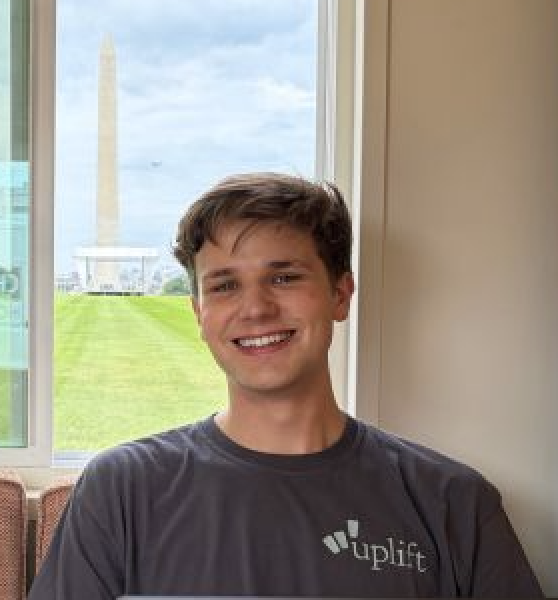
Charlie Nitschelm is the co-founder and CEO of Uplift, a company building affordable, rapidly deployable temporary housing. Uplift’s first product is a 90-square-foot, off-grid home designed for one to two people that can be transported fully assembled, placed with a standard forklift, and self-level without a foundation or skilled labor for deployment.
In this episode of Inevitable, Nitschelm explains how his experience at SpaceX and Starlink, followed by an intensive period of studying homelessness, poverty, and other social challenges, led him to think about housing as a problem that could benefit from a fundamentally different architecture.
The conversation explores how Uplift is designed to work immediately after deployment, including its approach to power, water, sanitation, connectivity, and remote monitoring. Nitschelm also discusses the company's manufacturing ambitions and its potential applications in workforce housing, disaster response, global shipping, ADUs, and affordable housing developments.
Episode recorded on September 15, 2026 (Published on September 29, 2026).
In this episode, we cover:
(0:00) An overview of Uplift
(1:38) Charlie’s path from SpaceX and Starlink to Uplift
(3:57) Learning about homelessness, poverty, and other social challenges
(8:22) Why housing needs a fundamentally different architecture
(12:00) Why eliminating skilled labor is central to Uplift’s design
(16:49) Forklift deployment and off-grid utilities
(23:33) Starlink, solar power, and building a connected fleet
(25:03) Applying car manufacturing principles to housing
(28:07) Workforce housing and infrastructure projects
(32:16) Why disaster housing can take months to deploy
(34:12) Global shipping, ADUs, and affordable housing applications
(37:04) “Speed to sleeping” and the economics of temporary housing
(39:58) Uplift’s manufacturing ramp and the path to HUD approval
-
[Cody Simms] (0:00 - 1:14)
Today on Inevitable, our guest is Charlie Nitschelm, co-founder and CEO of Uplift. Uplift is aiming to solve the problem of affordable, rapidly deployable temporary housing. The product is a 90-square-foot off-grid home that ships fully assembled, can be lifted and placed anywhere by a standard forklift, and self-levels on arrival, no foundation and no skilled labor required for hookups.The company recently raised a $7 million seed round from a16z and Valor. Their micro-homes can be used for disaster response and for frontier housing for construction and infrastructure builders. Two markets growing fast for very different reasons, and neither has a great solution today.
Uplift's bet is that the same box can solve both. From MCJ, I'm Cody Simms, and this is Inevitable. Each week, we talk to the people powering the world and keeping it running to learn what comes next.
Charlie, welcome to the show.
[Charlie Nitschelm] (1:14 - 1:16)
Thanks for having me. This is great.[Cody Simms] (1:16 - 1:37)
Before there was a company, before you started Uplift, I have heard, and actually you haven't even told me this story, but I've heard you kind of immersed yourself in this problem that you're now trying to solve. And I'd love to hear your story about what got you down the path of building Uplift in the first place.[Charlie Nitschelm] (1:38 - 3:02)
God, how long do we have? I come from an engineering background, so I worked at SpaceX for five years. I quit in 2025, so just over a year ago now.I decided I wanted to do something different. I wanted to solve the next problem. I think ultimately I worked on Starlink specifically, but ultimately internet is now a solved thing.
I can see the path over the next 10 years where anyone, anywhere in the world will have internet at a very low cost. It's going to be a great future. But yeah, I wanted to think about the next problem that's not being solved.
So I applied to MIT. I decided to go back to grad school, even though I said I think it's kind of useless. But actually, it was my personal renaissance.
Now that I look back at it, well, I didn't finish, but we'll get to that. When I got accepted to MIT, they sent me this book. I always say I've had two pokes in my life.
One was for the space industry. I watched the first Falcon 9 landing in 2017, 2016. The second was this book.
It was called Power and Progress. It's written by two MIT economists. I don't recommend books to people because it's very based on where you are in your state of mind at the time.
But it was a great book for me at that specific instance. It made me want to think about how I could create new technology, new engineering products directly for people that I think that would be hurt over the next 20 to 30 years. Because not everything we do in society helps everybody.
That's why we have government. That's why we have politics. It's to decide where we're putting focus because a lot of politics and a lot of debates, it's zero sum.
You're trying to decide where to put cash.
[Cody Simms] (3:03 - 3:14)
And progress is uneven, right? Some technologies that make things really great for some people make things not great for others. It's a tricky balance that is the march of progress, right?[Charlie Nitschelm] (3:15 - 3:42)
Exactly. And that's what this book did. It went through the history of the last thousand years, and they wrote it specifically to address what we're about to see with our AI revolution, which is currently happening right in front of us.Which will have profound positive impacts. I think everyone 100 years from now, hopefully, will be looking back and be like, wow, we are living a much better dignified life. But they talked about these transient periods, and they used other tech, obviously from the Industrial Revolution and on, to describe that it actually hurts a lot of people.
[Cody Simms] (3:42 - 3:56)
Fossil fuels is a great example of that, where it's lifted many people out of poverty and yet also causes so many disasters and is the thing responsible for climate change and you name it. There are tricky technologies to navigate sometimes.[Charlie Nitschelm] (3:57 - 4:50)
And the most important, to answer your question, the most important thing this gave me is it made me want to learn of people's struggles that I wasn't aware of, or I didn't really think critically of. I think a lot of us go day by day dealing with our own problems, but I think there's a whole world of deep poverty in America that I think a lot of the technologists, engineers, aren't really thinking to create products directly for them.I am still a believer of trickle-down economics and essentially building more goods and services ultimately will help society as a whole. And that's all of our jobs as engineers and builders and suppliers. It just made me want to think, what can I make that can immediately help the people living today, my neighbors that are struggling?
So it made me want to read some more books. And the TLDR is over the next six months, without wanting to build a company, I just read. I was in grad school at MIT, and over the six months, I read 78 books on –
[Cody Simms] (4:50 - 4:54)
(4:49) What program were you in?[Charlie Nitschelm] (4:55 - 4:58)
(4:50) I was in MIT Leaders for Global Operations, which is a dual masters at MIT. I actually would recommend it. It was quite great.It exceeded expectations for me.
[Cody Simms] (4:58 - 4:59)
It sounds like you had a lot of free time for reading.[Charlie Nitschelm] (5:00 - 5:59)
I did. I read eight hours every day. When I look back, it seems like a lot of work.In the moment, it was just so passive, but also active in terms of what I was trying to find. So I kind of designed the six-month journey as every month was a different subject. So the first month, I read this book called Abundance, which a lot of people have read by Ezra Klein.
It's a more popular book. It had an excellent chapter on homelessness. That made me want to dedicate the month of June to, essentially, a lot on homelessness.
Some memoirs, some critiques, some analysis of how to address it, etc. That led me to learn more about mental illness in July, drugs in August, general poverty in America in September, and then October was religion. With no true aim, I was really just very curious of problems that I have not had to experience, thank God.
A lot of people do. It made me feel a lot of things, but it actually made me feel quite empowered because I feel like there is action that can be taken. And I love action.
I love doing things.
[Cody Simms] (5:59 - 6:27)
I love hearing the story of taking the time to immerse yourself in something. I know I am guilty of way too often flipping between different things in not even 30-second increments, but, you know, two-second increments as I'm scrolling through X or Twitter or whatever else I'm looking at. And actually creating the space in life to decide you want to go deep on something certainly sounds like quite a privilege.[Charlie Nitschelm] (6:28 - 6:52)
It is a large dedication of time. I mean, there's levels to reading. I think you can kind of start with just reading articles on X or, you know, essentially few-minute reads.Then you can get into an entire book, which a lot of people still have fallen off from doing. And then there's a level above that, which is a collection of books of many opinions on one specific subject. A lot of people just read one or two books on a specific subject, and then you really just get the opinions of those two authors.
[Cody Simms] (6:53 - 6:53)
That's right.[Charlie Nitschelm] (6:53 - 8:19)
And books are very personal. So all these months were a spread of opinions.I had questions on my mind, of course, during reading, but it was really just to become aware of arguments and the past and the history of it. Through that period of my life, which was from May to October of last year, I started to think, what could be a capitalistic company? I'm definitely a strong believer that a for-profit company is driven by correct incentives to really try to make a profit for society.
So what is a company? What is a product that I could build that could actually scale? In a lot of these books, I see a lot of nonprofits that are essentially just trying to solve homelessness with essentially grants or donations.
All of the examples in those books that I read there, it really just scaled to maybe one city, and then it died off after the person who was leading it became not interested anymore. But then when I look at these huge services that we all get in society that scale to all of America and they sustain themselves, those are capitalistic companies. Firm believer, obviously, you need great leadership and good direction and vision to make it a really good thing for society, especially for something that might address poverty, temporary housing, something very human.
Obviously, the company we're building here at Uplift is something that's very human. It's a home. We're architecting a new type.
The product was kind of formed throughout these books, these stories, understanding what goes wrong and why. Where can you put that little nugget, that little piece of new tech, that new engineering to uplift people in these environments?
[Cody Simms] (8:19 - 8:22)
What led you to temporary housing?[Charlie Nitschelm] (8:22 - 9:54)
Well, there's some bias here. I'm a hardware person. I love building physical things.Obviously, when I was reading all of these memoirs and literature, it was always in the framing of, what could I produce? What can I put together as steel, wood, a bunch of software inside it and make something that's useful? As I was reading all this, I was really architecting that and building this kind of vision of this company on the side.
Now, if I was purely just a software person, I probably would have had a whole different framing on the problem. What could I address? But it became very apparent that most people would agree, we just don't have a good type of house.
I just don't think we've explored all of the architectures. Obviously, I can talk in detail on the housing industry in general. So many housing companies have come and gone, and there's reasons for it.
Very hard legal regulatory barriers for housing. There's a lot of laws built up from the problems of the past that you have to get through, which is also essentially headwinds in every company that's launched. But yeah, it's an extremely hard problem, and I don't see it getting better.
Every data point I saw, and I think homelessness is a great data point. Rent in America is a very great data point, which there was great analysis I read on the causes of homelessness that I can go on about. But nothing's getting better, and I don't actually see new startups actually making the 2x, 3x, 4x improvement that we need to see.
Whenever I looked on housing, it's always like the 3% better, 7% faster. But when I think of the big things that's changed my life around me, it's the Falcon 9, it's the Tesla, it's the thing that just changes games. We need a game changer.
[Cody Simms] (9:55 - 10:07)
And so what led you from that meta problem of housing itself needs a game changer to, oh, and the temporary housing space is where we should start with something?[Charlie Nitschelm] (10:08 - 11:46)
God, yeah, there's a housing crisis at every level. Families, individuals, luxury, affordable. I needed to explore something that I could produce and just release into society.This was biased from my experience with working on Starlink. We really were set up to be able to produce this Starlink customer kit, and we didn't need to know the address it was specifically going to when it was on the line. We just needed to make as many as possible.
And we need to get it into a box and be ready to deploy it. Now, there's two problems there. One, production's really hard.
You got to make stuff. I think people completely underestimate how hard it is to go from maybe 10 units made a year to a million units made. It's just a completely different class of engineering.
And when I thought about all the different homes that I could build, something that seemed very attainable as a first step for a company was a home that was a similar size to a car. I know that there's infrastructure around the world built, supply chains built on this kind of size thing. And when I looked and started reading about how we deal with temporary housing, people wanting a space for a year, two years, it became apparent that there was a great entry into the market currently for a new type of tiny home.
And as I had that thought in my head, I then started reading about people's lives and how people live in construction projects, refugees, homelessness, ADUs. I then started to understand, okay, what are the problems for those markets? Which is how the first Uplift product, which we're calling Uplift, came to be, the architecture.
[Cody Simms] (11:46 - 12:00)
Which leads me to ask, what's broken with temporary trailers, the ADU market, things that seem like these feel like solved problems, are they actually not solved?[Charlie Nitschelm] (12:00 - 12:37)
If we zoom back to 2000 and we're talking about rocket launch, like, yeah, we could get people into space. I mean, we solved it. It's there.You can do it. It takes a lot of work. Now it's like every day is a Falcon 9 launch.
You forget about the past. It's just like a thing, a new class. And this is where getting to the crux of what the product is.
One thing I was very surprised about, and I'm always looking for someone to prove me wrong, is that specifically in the temporary home, small home markets, there's a lot of them, but take that as a global statement. No one has deleted skilled labor required. There has not been a single product that has deleted the requirement of skilled labor to deploy the home.
[Cody Simms] (12:38 - 12:40)
Trailers don't? You need a skilled labor to hook up a trailer?[Charlie Nitschelm] (12:40 - 16:29)
Obviously, you can pull up for a day a trailer on the road. Obviously, you can live on the road. That's a little different.Let me pair my statement with something, because when I say no skilled labor, it means that you don't need an electrician, a plumber, any kind of foundation set, and you can start to live indefinitely without the requirement of even calling any of those people for help. And of course, the trailers get close. They're also extremely prohibitively expensive.
They have to be maintained as a car on the highways, which come with its own hurdles and maintenance and operational costs. And they don't really scale when I think of large villages that you can start to make. Not to mention, these markets are so incentivized to cut costs because they're already so expensive that it turns out to be a very undignified place to live unless you're buying a premium one.
What we're really trying to make here is a dignified home that can be deployed without the need for skilled labor. And then there's a lot of cool other architectural decisions we're making to drive down its cost to deploy it. So therefore, you can really truly have a very valuable asset once deployed.
And then once you have that asset and someone's living in it for six months, a year, it is economical to quickly pick it up, plop it on a flatbed, and move it to the next spot. Why don't you describe the product? So we're calling it Uplift.
It is a 90-square-foot tiny home that houses one to two people, so it's not made for families. And it is essentially a fully off-grid, dignified place to live. And I think the best way to describe it is kind of describe the life cycle of it, how it comes from the factory and how that deploys to its first site.
So really, the comparables to a car are quite convenient, although it doesn't have wheels. The way it's transported and moved around is actually quite novel and actually will make it more economical to transport around the country and actually the world. The whole home, fully assembled with everything internal, already assembled, gets picked up and moved around with a standard forklift.
It can then get placed onto a flatbed. So say it's coming out of the factory, a forklift picks it up from the end of the line with everything inside. It places it on a flatbed, four of them, because they're 12 feet long.
Then one flatbed operator, driver, can drive across the country and actually deploy four homes, which is four times more effective than if you drove a single large trailer with one driver. So you get a four-unit-per-driver efficiency there. The same home, also as a side note, can fit in the standard maritime containers of the world.
So you could actually rail it, put it on barges, and ship it around the ocean using standard freight. So the effectiveness of that is actually quite high. When you think about costing anywhere in America, I could get an Uplift for under $2,000 anywhere in America.
I could get it to the shores of Gaza for under $5,000. We're just so great at shipping internationally now with barges, et cetera. We've optimized that over 100 years.
We should definitely optimize the home to fit inside that. Now, mind you, it's important to realize that leading the cost to deploy is actually a very significant challenge and opportunity. I like to look at disaster relief as a lens because all the costs are very public from FEMA on how they deploy their trailers or their temporary housing structures and manufactured homes.
They spend more money on the deployment and installation of these transportation homes than the actual cost of the entire large trailer itself. So on average, $100,000, $150,000 they're spending, more than half is just the deployment of it. So then if you were someone that did a 12-month stint there, you just set up these trailers, you spent all this money, of course it makes sense that they don't want to pick it up and move it again.
It's a nightmare to try to transport it to another location. So they just sell it for pennies on the dollar.
[Cody Simms] (16:30 - 16:31)
And who said government was inefficient?[Charlie Nitschelm] (16:32 - 16:35)
It's sad because the people working on it want to get more efficient.[Cody Simms] (16:35 - 16:36)
No, of course, of course.[Charlie Nitschelm] (16:36 - 16:49)
It's a painful battle, but that's why we have a private capitalistic country. That's why you just need to be able to innovate, sell to the government in a better way so we have more valuable assets. That's what we want to do here.We want to provide them a better tool.
[Cody Simms] (16:49 - 17:15)
You're pointing out a problem that these homes are, for disaster recovery in particular, are set up with the intention to be portable so that you can go from disaster to disaster. But the incentives and economics behind them in terms of how they're actually deployed into disaster scenarios actually are counter to that. They are incentivizing these homes to stay in place once they are deployed.[Charlie Nitschelm] (17:16 - 17:27)
Just a consequence of the product design. These trailers weren't designed to do disaster relief. They are just being sold because it's the current best option.And as a result, it's just not a good product for who you're trying to serve.
[Cody Simms] (17:28 - 17:41)
So coming back to your product where you said the requirement is there's no skilled labor involved, I would presume that means the deployment cost is substantially lower. What does that mean that you can actually set them up operationally without skilled labor involved?[Charlie Nitschelm] (17:41 - 18:52)
It's wild when you first see it. I do want to reiterate that the architecture that we're building, I think it's important because I think for housing, if there's any new way to do something, we have to try it. It's just such a large problem.What's pretty cool is the architecture that we're making has not been tried before. No one has built what we're doing in terms of feature set. So let me describe the deployment.
So when the flatbed, obviously it's described from the factory, has four on a flatbed, they're driving to a location, say it's going to a community village outside Detroit. A forklift, which is a 5,000 pound forklift, the most ubiquitous infrastructure that we have around the country, can grab the homes from the side of the flatbed and place them wherever you need them. Now, it's important to note that each Uplift actually comes with the ability to self-level.
So as soon as the forklift plops it on uneven terrain, doesn't need any work on it. You walk in, you say, hey Uplift, can you just self-level please? And it will self-level the home, turn on all systems, and you could quite literally close the door, HVAC turns on, there's a hot shower ready, there's lighting, there's music that you can connect to, bed, kitchenette, we can go through all the features.
But it essentially has everything we think someone needs for a dignified place to live.
[Cody Simms] (18:52 - 18:57)
Without being plugged in anywhere just based on its own solar array and battery, I presume?[Charlie Nitschelm] (18:57 - 19:17)
Yeah, and that will only last you, you know, so long. But we're making the ability to give more energy, say on a lot of rainy days, or give more water so simple that anyone can really intuitively refill this unit. So that's where a lot of the engineering is going, is to make this essentially the most efficient home ever.[Cody Simms] (19:17 - 19:29)
So it works immediately on the drop, where you can walk in the door and have it functional. And then if you do need to extend it in terms of adding water or power, what does that look like?[Charlie Nitschelm] (19:29 - 21:39)
Let's walk through each of the utilities. Power, water, and of course toilet. So power is actually quite simple.There's obviously a 110 outlet on the outside of the home. So you can run any extension cable, say if you did have power nearby, you can run the same from an outlet that you charge your iPhone with every night. You can run that to a home and it will run it indefinitely.
In fact, actually one outlet can run two homes indefinitely. That's how low power we're talking about. Worst case scenario with HVAC running, like 110 degrees outside, cooling it to 70, you're talking 700-800 watts needed for the home.
So quite low. Then of course swap out the connection to that grid. Obviously it's an off-grid vehicle.
You could actually just have a backup generator that actually gets signals from the home to kick on during the day. It ups your battery during the day when you're out, turns off at night, and it's fully quiet off-grid throughout the nighttime. So an asset that most people know how to use, you just plug it in, you're good to go.
The home can even ship with this generator and all you have to do is make sure you fill it up just like any other generator. So that's power. Let's talk about water.
Water I think is a bit more, it's heavy. You need to think about it. But really what we're doing is we're also making it kind of bulletproof.
The home has a garden hose connection. I'm a true believer that every American knows how to use an extension cable and a garden hose. That's our plumber and electrician in us, you know.
All you need is to hook up a garden hose to the home and the other side of that garden hose has to be connected to some water source. It doesn't even need to be pressurized. So therefore you can kind of think through getting that water inside the home.
Automatically pumps it in, fresh water. We have detection of everything inside the home. We know how much power, we know how much water.
We know what power is going through specific chips on our controllers. There's full control over this home. So when someone hooks up their water, it'll essentially signal, request water whenever it needs it and it'll fill it back up.
It's very economical. The same forklift that forklifts the home, there are already these palletized water tanks, 300 gallon that a lot of disaster, actually it's already solved problem for disaster relief. They drop these pallets of water.
That could be a way to maintain a fully off grid home. If you didn't have a garden hose connected to a actual water system.
[Cody Simms] (21:40 - 21:46)
Does the home have some sort of bladder or something you can fill up with the garden hose and then detach so your neighbors can go do the same thing?[Charlie Nitschelm] (21:46 - 23:19)
The home comes with water. It has onboard water and a gray water capture that you can drain or pump out somewhere else. So yeah, no, that's why actually when the forklift drops it, the home will actually have water inside it already.You'll be able to live for a whole day. No problem. Immediately useful.
Just like when an iPhone ships to you and you turn it on, it's already battery powered. This is the same thing. It works right away.
So that's power and water. I think water will also learn over the next few years how to make it easier and easier to essentially fill water, make the home more efficient. We use less water, which will be a good recursive loop for us because we're very incentivized to do that.
The user would very much like to deal with water less. For example, the toilet is the third one. This home will never use black water.
So it will always be an engineered compost toilet among other categories that we can consider. But it will essentially integrate into the home. It'll be in the shower area, which our shower is going to be a beautiful instant hot water shower.
It has a stored water tank inside, but it'll feel instant as soon as it turns on the perfect temperature every time. And the toilet will be integrated into the wall there. I don't know if you're a compost toilet user.
They're actually quite bad the way we deal with compost toilets, the way people have made them in the past. We are going to engineer a new type of compost toilet that's custom integrated into the home where it feels exactly the same as a typical toilet that you use just when you're connected to sewer. The only extra task which we need to make as easy as possible is maintenancing it from the outside.
A general rule of thumb for us is we want it to never smell inside. You want to never see what you've done before. And when you sit, it feels like you're sitting on a normal toilet.
So those are our requirements. And we're going to start iterating that and engineering it into the home.
[Cody Simms] (23:19 - 23:32)
The fourth utility, I suppose, which is probably obvious, would be internet. And I'm guessing we're in a kind of post-Starlink world here now where that's pretty much just a solved problem. But let me know if there's anything I'm missing in that regard.[Charlie Nitschelm] (23:33 - 24:37)
Of course, each home will come with Starlink. The whole roof is essentially 93% solar in terms of surface area. So it's 1800 watts, which is quite a lot for the home.And then there'll be Starlink sticking out as well as some vents for other systems inside. What's really quite exciting, and actually, I mean, the whole software of this home we'll have to talk through, given that it's always going to be connected to the internet. But as this home travels, we'll essentially have pure connection.
It's a connected fleet. So when you start to think about companies or developers, nations owning these homes for disaster relief, refugees, et cetera, it won't be just this hard asset that you have no idea what's happening inside or anything. It really will be a modern day home that you want a home to be.
You can understand its levels, where it is, what it's struggling with. You'll be able to communicate with occupants inside and give them messages and understand what they're going through if it's a specific scenario. We'll really have full control.
We'll be able to build out this website platform for anyone who buys these and serves them, essentially a fleet website. It'll essentially do all the features that maybe some companies build in-house to track their homes. We'll be able to integrate that as a package with this system.
[Cody Simms] (24:37 - 25:02)
Taking that fleet analogy further, and obviously you worked at SpaceX, not Tesla, but clearly Tesla is taking a fleet approach to how it's building its cars going forward with the cyber cab and all of that. I think it's interesting to think about that and hear some of the analogies I've heard you say about approaching these homes the way car manufacturing has been made.[Charlie Nitschelm] (25:03 - 25:48)
My co-founder, Trevor, he came from Tesla. He was there for around five years as well while I was at SpaceX. The car comparisons to the vision of this home is so useful.I still hate using it because it doesn't have wheels, and I think that's a big part of the home. It really looks beautiful. I think trailers have always a negative connotation given the wheel aspect of it.
But in the factory setting, it also is great to compare it to what Tesla is doing because when you're looking at this site, 90 square feet, all of the machines today, all of the production equipment has really been sized for that. When you ask the question, why don't we build a home every minute? The only reason you and I drive a car is because we've figured out how to make them one a minute.
If we made it like the Model T, only the top class will afford a car. Actually, it would be far worse of a car as well.
[Cody Simms] (25:48 - 25:52)
I mean, that's Ferrari, right? That's what Ferrari does is they build every component by hand.[Charlie Nitschelm] (25:53 - 27:09)
Yeah. If you watch videos of the Ferrari, it's still using the good production equipment that make the parts. This home, there is no technical reason we won't be able to adopt not just the production processes, but also the talent to create those production processes to make this home every minute.For those who don't follow how much homes, we make around 1.25 million homes in America every year. That's currently our status. Constantly, the deficit is increasing, just like our debt is always increasing.
Our housing crisis is always increasing. It's interesting, 1.25 million homes a year. When you think about a car factory, if you made an Uplift every 30 seconds, so one really great car factory, you would double the housing production of America with one factory.
It's quite insane. Mind you, pair that with an Uplift. There is no technical reason, although we need this development process over the next couple of years to really refine the module design, et cetera.
I can talk about our production ramp, but there is no technical reason we cannot do that. The question in my mind is, can we show that there is a proof of demand throughout America, throughout the world of this kind of new architecture? But if we get that, there is no reason we cannot do that, and this home will be of far less cost than everything else out there.
[Cody Simms] (27:10 - 28:07)
That's a great segue because I want to talk about the markets you're going after to begin with. I will start this conversation by saying I've met many, many companies building attempts at modular housing over the years, and I think every one of them that I've met is in some way, shape, or form trying to do something to displace the way single-family homes in America are built. There are lots of ways to approach that, but in general, it's trying to solve the problem of building the classic American home, quote unquote.I feel like you are taking a very different go-to-market approach based on demand pull. Maybe describe that. Not that there isn't demand pull for this classic single-family home in America.
You're solving a very different kind of demand pull.
[Charlie Nitschelm] (28:07 - 29:32)
It is. I think it's a little bit more not-in-your-face. Everyone can envision the single-family rural America homes, and a lot of modular companies building wall segments and making it much more efficient in the building process, which is still useful.I love when people find the 5%, 10% gains, and we still need those. Our product, it really will be for different markets, different types of people, and there aren't really other players trying to make what we're making. I really hope that other people start to get on board and want to build this architecture.
That would be a pretty great celebratory moment. I think copying a type of product is one of the nicest things someone can do for you because it shows that other people are getting really excited and want to build it too. Our markets are different.
I can go through some of them, but what we think is our beachhead markets that we're approaching now and getting a good amount of interest in is workforce housing, which I think will be one of the largest private first segments for us. When I say workforce housing, this will be a lot of the hyperscaler infrastructure projects that are going on in America right now. You can think energy, data centers, a lot of just rural work.
With all these large infrastructure plays that are increasing demand, now a lot of rural work is also having a hard time getting employees. This is fascinating. We find that housing is actually a key problem for getting this stuff done.
That shouldn't be the problem. The problem should be, how do we make better chips? How do we build these faster?
That should be problem. It shouldn't be where my engineers are sleeping during the night, not traveling two hours in.
[Cody Simms] (29:32 - 29:38)
In this way, the Uplift becomes the future of the factory town, I guess, would be the way to think about it?[Charlie Nitschelm] (29:39 - 30:25)
It will delete the problem for them. They can not only incentivize employees by, hey, look at these beautiful temporary homes. You're going to love being here throughout the week.This is much better now. If you really research what the status quo of what we call man camps today, the conditions can be quite poor. They pour so much money into it to make all the community features much better.
The actual place where someone sleeps, either you're paying an exorbitant amount, like $200,000, $300,000 for an Airstream, which still has its deployment problems, or you're just getting good community engagement. At the end of the day of a 12-hour workday, you just want to rest. You want to be by yourself and hanging out, recover, be ready for the next morning.
I really do think that the whole industry for workforce housing needs a big innovation for where someone sleeps. It will always be paired with community features, but where someone actually goes to bed.
[Cody Simms] (30:26 - 30:48)
You think back 100 years ago, and you have these ghost town remnants all across the Western United States. You can imagine the 2026-2030 version of that is there were these camps and these Uplifts or whatever were there for a year or two. Then they moved off and ideally left no trace.That would be the best possible outcome, I think.
[Charlie Nitschelm] (30:49 - 31:05)
Exactly. Actually, when you look at the period of maybe a three, five-year-long construction project, the demand for housing changes drastically. Some months you need $5,000, then it goes down to $1,000.By making something so easy to move and utilize somewhere else when you don't need it, we'll just make it a very valuable asset. That's workforce housing.
[Cody Simms] (31:06 - 31:14)
When I saw you, the original pitch you did on Uplift, which you did at MIT, I think six months ago, if that. Not too long ago.[Charlie Nitschelm] (31:15 - 31:15)
Four months.[Cody Simms] (31:16 - 31:26)
It was very much focused on disaster relief. I'm curious how you first thought about that market and whether that's one you still see as a strong market for the product.[Charlie Nitschelm] (31:26 - 32:02)
I still see it as a strong market. It's one of those other ones where the emergency of it allows, I think, new entrants to get into the moat of housing in America and hopefully retain it, given that it maybe exceeded expectations. Also, there's a whole political landscape of FEMA wanting to do less operational work, contracting more to private companies.Those companies get contracts from specific states. There's a way to not actually sell to the state themselves. We would actually sell to these contractors that already have contracts with states.
Essentially, hey, use our home instead of this because you'll save X dollars. It'll be this much better.
[Cody Simms] (32:03 - 32:14)
Paint the picture of the challenge that disaster relief has today. You gave a little bit of the economic incentive problem earlier in our chat, but you told a very compelling story in the MIT pitch that I had a chance to see.[Charlie Nitschelm] (32:14 - 32:16)
The headline, I think, that's most significant.[Cody Simms] (32:16 - 32:23)
Compelling is the wrong word. You told a very powerful story about the challenges in this space.[Charlie Nitschelm] (32:23 - 32:44)
There's several. The headline that's very important is that the best case scenario for new housing to be at the location of the disaster, to house maybe the people in disaster, to house the workforce going into repair and address the problem, is four months, four months after. When we zoomed into why, asked people at FEMA, we obviously queried as much as we can from the internet.[Cody Simms] (32:44 - 32:52)
This is like after a wildfire, after a hurricane, after some large act of God, the best case is you get housing four months later.[Charlie Nitschelm] (32:53 - 34:09)
Yeah, from the federal and state government. Obviously, people can go in with their trailer four days in and try to serve one person, but I'm talking about addressing it as a nation. Four months.For the fires in Malibu, it took 13 months. Once it got there, it's almost useless. It's not serving the people that were in immediate need, living on the street, living with their friends and family three hours away, not rebuilding their home, which is the lens that we looked at and started to see, why does it take this long?
We started to figure out that foundation preparation, requirement for utilities to live a dignified life, transportation, all of these things were causes for the four months, causes for high cost. The Uplift architecture is to quite literally delete all of those things that cause a long timeline. You don't need this significant foundation preparation.
You don't need to be off-grid, so you don't need these huge camps that need all this work done. You can do smaller villages in a bunch of discrete areas. In the transportation logistics, you don't need a multi-car entourage to deliver just one unit.
You could have one driver, these drivers that all come across the nation to help. They're essentially this much more effective because they can hold four Uplifts. The disaster relief is a really great lens of, and actually a great proof of why this architecture can be very, very useful.
[Cody Simms] (34:09 - 34:12)
Any other spaces that you're looking at right now?[Charlie Nitschelm] (34:12 - 36:52)
There's going to be huge markets once we start to show large credibility of units. People desire it. People want it.People want to buy it. It gets to a cost that makes sense for them, given production ramp. The things that come to mind that I'm most excited about is shipping globally.
China uses manufactured housing as a huge form of support to their other countries that they're trying to form better relationships with. It's a form of soft power at the end of the day. I see that the United States sends cash.
They can send tents. But three months, six months after other nations' disasters or refugee crises, nothing American is left. Nothing says made in America on the door.
But then all of these Chinese products or other countries' products remain. So when I think of the ability for this home to be shipped on barges economically, I actually think we can compete and actually exceed the expectations and provide a really valuable asset for other countries across the world. So I think it has a global play, maybe through our government and through just selling to other nations.
And then, of course, internally, once we start to get HUD-manufactured label and people trust this home, they think it's reliable, it's ready to be deployed, the ADU market is going to be a huge one because it's just so easy to instantly make an ADU online. It'll be like a joke when you compare it to other companies trying to place an ADU in terms of number of hands that need to be touching it. And then, of course, affordable housing developments, which is actually a fascinating play as well, which I can go into detail for.
Developers, when they build out affordable housing complexes, they buy lots outside the city. They sit on them while they accrue proof of demand, they accrue value. And at a certain point, it's worth the capital investment.
You have a guaranteed return on equity and you build a home or build a complex. Now, we can get into why people are typically always building luxury housing, which I'm sure a lot of people see in housing. But the more important part is the lots sit for a while.
A large amount of lots are sitting idle. There's a reason. They don't have connection utilities.
They're not really made. They're still uneven, et cetera. This is a perfect opportunity of land that is currently not useful to anyone to be instantly useful using an Uplift.
Because there is no fixed cost of getting these homes to be active, living a dignified life in that area. Meaning that when a developer wants to build on it, you can essentially move these temporary homes that are giving monthly rent to people out maybe another mile from the city. Then they can start to build an apartment.
So it actually is essentially just new revenue that doesn't exist. A new profit, which would be a profit for both the consumer and the company, that's instantly made by having this kind of architecture. And there's a reason that we're not doing it now is because a product does not exist that allows them to do that legally and economically.
Economically, we're telling ourselves legally we have to get more approvals. That's a permitting.
[Cody Simms] (36:52 - 37:03)
We talked in the data center, AI and energy world about speed to power. You're talking about like speed to sleeping. Like getting people into the unit and into bed at night as fast as possible.[Charlie Nitschelm] (37:04 - 37:07)
It becomes so easy. It really is one part number.[Cody Simms] (37:07 - 37:33)
On the sort of thinking about it on a per night basis, I've heard you talk about that as being ultimately the sort of economic target for the company. What more can you share about cost and how an Uplift might compare? Whether you want to talk about it on a per unit basis or whether you want to talk about it on a per night basis, just helping people understand how ultimately these will be priced in the market.[Charlie Nitschelm] (37:34 - 39:48)
When you go looking for a car, that typical metric people look at is the cost per mile all in. Cost for all the fuel, cost for all the maintenance that's expected, etc. It's actually a very valuable metric because it kind of factors in all the hidden costs that you don't think of that aren't the sticker price.So for housing, you would think transportation costs, how many deployments you're doing, you'd add all those up, the deployment costs, the cost of energy, etc. And we don't do it. If you did that for a temporary trailer for FEMA, it would be three, 400 bucks a day.
I think, I'd have to check for math, but it's around that value because they last for around 18 months maximum. They cost 150K. I think temporary housing needs to start to adopt this metric.
That's where you'll start to see the usefulness of the Uplift. It's really what people care about, especially when you factor in the cost of money over the time as well. So take the Uplift.
When I assume Uplift sticker price of $35,000, kind of like an average car, and I assume that I'll be able to build the home interior, the ability to make sure it's maintainable, very economically. Say it lasts for 10 years. That's around 10 bucks a day, not assuming for the cost of money.
And then when I factor in, okay, people are going to be doing operational things to it. You're going to have to refill water conservatively, being very conservative. Say someone owns this asset, 20 bucks a day for housing.
Now, if we zoom out and do some calculations for current housing in America, I think the federal government actually is a really great indicator. They provide a per diem for federal employees as they travel within the continental US. Each state is obviously different for the per diem, but the average is around, I think it's sitting at $105 right now today, $105 bucks a night for housing.
It's a great metric because that's what they think the average cost of housing is in America. So if you make an asset that can deploy very easily, and it all in, when you factor in it lasts for around 10 years, that's also a factoring of the transportation, et cetera, that you expect over the home lifetime of 20 bucks a day. It's like when you think about cost of space, there's a cost per kilogram to orbit.
SpaceX is essentially 10X less that with the Falcon 9. It's 10X less now than what it was before. And Starship will do another 10X, which is just wild.
This home will be essentially a five or six X cost reduction per night. And all we need to execute on is that we can sell it for 35K, we can make it last 10 years, and it can generally do what I've described in this podcast so far.
[Cody Simms] (39:49 - 39:58)
What is the current state of doing that? You've got your first unit off the line, I think, at this point, and you're starting to ramp up manufacturing. Is that where you are?[Charlie Nitschelm] (39:58 - 41:08)
Actually, I'm sitting in the factory right now. We have a little reading room in the factory space, but we're a relatively new startup. So we got our seed funding by Andreessen Horowitz with a follow-on investment with Valor three months ago, four months ago now.Yeah, very early, but we're moving light speed. I hired a lot of SpaceX, Tesla folks, builders locally in Austin, Texas. We moved here from Boston.
It's been a sprint. We built a factory. We built our next product with the team, which essentially was an engineered feature set.
The first one we built in Boston was more just like thrown together to show the vision. This one, someone can and will live in. We're essentially at the rate where I think early car companies like this too.
You build one, you learn a little bit, you build another, then you start to build a few on a line at the same time. That's what we'll be doing over the next three to four months. While we do this, we are seeking contracts for customers who want to order many of these.
With the recognition that we're going to need to build a larger factory, you're going to need to wait 12 to 18 months to get a significant quantity from us. I think there are many companies out there that will be very interested in this product, not just because it will save them money, which they will, but it will also save them the headache of dealing with a thousand part numbers to house the people that they just want on site right now.
[Cody Simms] (41:09 - 41:15)
I don't know if you call it Uplift One, but whatever you call it, the first unit, you're taking it to DC today, you were telling me before we started recording.[Charlie Nitschelm] (41:15 - 42:44)
It's leaving tomorrow morning. This is extremely exciting. HUD, Housing and Urban Development, invited us to their Innovative Housing Showcase, which they've been doing each year for four or five years through the Biden and Trump administration.They invite just some housing companies throughout America to show the innovation that's happening in housing. It's going to be a great opportunity. Secretary Scott Turner is going to come by.
I'm sure a lot of senior officials, et cetera, will be visiting. It'll be a time for them to see this new architecture of a home. Currently, it's very important of what we're building because the ROAD to Housing Bill, which was essentially the largest legislation that we've written for housing in the last 50 years, for sure, since I've been alive, was passed in July.
There was one specific rule change that was very important for Uplift. Manufactured housing per HUD, which we do want to meet, had one statutory rule that said it had to be built with a chassis, a chassis as defined as a wheel and axle. That's why you see a lot of manufactured homes have these wheel and axles strapped on.
They changed it to with or without a chassis. I think the reason was they just wanted to save $3,000 or $4,000 from the current manufacturers of today to make it $100,000 to $96,000 to make it. HUD officials actually came by and visited our factory a month ago.
What they're very surprised about is it actually enables exactly what we're building because the transportation method does not use a wheel and axle. We hope to excite them about the product, talk through some of the HUD regulations that we'll have to talk through to be able to proliferate this through America. But ultimately, our goal is over the next year to form a great relationship with them, show it's a very reliable home, and get that HUD manufactured label.
[Cody Simms] (42:45 - 43:10)
As you're building over the next five years, you're pursuing these multiple paths, as we talked about, from disaster relief to workforce housing for the AI boom and whatnot, to affordable housing and other temporary housing solutions. That's a lot for a small company to focus on while scaling up manufacturing in parallel and refining the product. How do you do that as a founder?[Charlie Nitschelm] (43:10 - 44:46)
Well, that's a big question. It's hard. I mean, that gets into the topic of how do you run a startup that has to deal with a bunch of different stuff, have a great team so far.My main job is to make sure that the team is set up for success. And it starts with the people. Obviously, I recruited some people from my past that I really trust.
Trevor did as well. And yeah, we have to do everything everywhere all at once. But we have to also be very methodical on it.
Housing is crucial. It's important. It can't be done in haste.
It has to be done with care. At the end of the day, this is going to house Americans, specifically Americans sometimes in the worst time of their life. It has to be a product that bleeds that we cared about that.
They can't just be thrown together. I mean, just like when you buy a car, you hope that it was built with care. It has all the features that you think will let you experience a great drive.
This has to be just like that, right? Every square inch will be thought about to maximize the performance of the home. And I think a lot of homes have not really done that in the past.
And people will be surprised how amazing 90 square feet will feel. Not to mention how easy it will be to deploy, make. It could solve a lot of issues.
So your question is quite difficult to answer. I just work all the time. I love it.
I think a lot of the people here are quite inspired to solve the housing crisis. I think it's a generational problem. A lot of people my age feel a loss of hope that anyone is solving it.
So we're always looking for people that are passionate about allowing people to be in very dignified homes. And not be constantly in this poverty loop, slum loop. Building more dignified homes.
That's really what we're trying to do. Charlie, anything else we should have covered today? No, you did a great job with the questions.
Thank you so much for the time.
[Cody Simms] (44:46 - 44:52)
I'll let you get back to loading Uplift One onto the trailer for DC. And really appreciate you making the time today.[Charlie Nitschelm] (44:52 - 44:52)
Thank you, Cody.[Cody Simms] (44:53 - 45:06)
Inevitable is an MCJ podcast. Learn more at mcj.vc and subscribe to our newsletter at newsletter.mcj.vc. See you next week.